
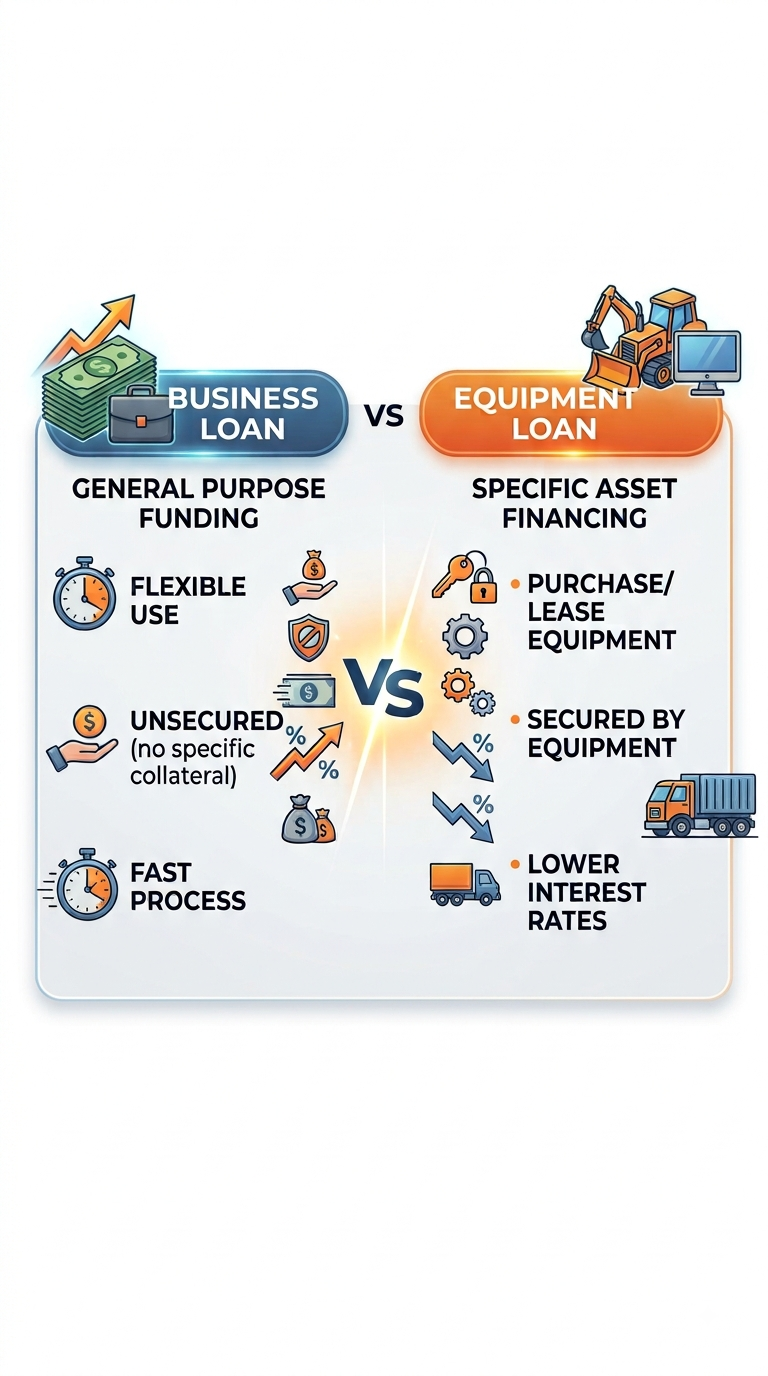
Choosing the right type of business finance can have a significant impact on your cash flow, repayments and how you fund future growth.
A business loan and equipment finance can both provide access to funding, but they are designed for different purposes. Equipment finance is generally structured around purchasing a specific asset, while a business loan can provide broader access to funds depending on the product and lender.
Understanding the difference can help you decide which finance option makes more sense for your business.
A business loan provides funding that can be used for a range of business purposes, depending on the lender and loan structure.
Rather than being tied exclusively to one piece of equipment, business finance can provide greater flexibility for businesses that need capital for broader expenses or growth initiatives.
A business loan may be used for purposes such as:
The amount available, loan term, interest rate and security requirements will depend on the lender and the strength of the application.
For a business owner who has several uses for the funding, this flexibility can be particularly valuable.
Equipment finance is designed specifically to help businesses purchase equipment or other assets.
Rather than providing general-purpose funding, the finance is linked to the asset being purchased.
Depending on the asset and lender, equipment finance may be available for:
There are also different equipment finance structures available, including chattel mortgages, finance leases and hire purchase arrangements.
The most suitable structure depends on the asset, business circumstances and how the equipment will be used.
The biggest difference comes down to how the funding is intended to be used.
A business loan generally provides broader flexibility, while equipment finance is specifically designed around acquiring an asset.
For example, if a construction business needs $150,000 to purchase an excavator, equipment finance may be worth considering because the funding is directly connected to the asset.
If the same business needs $150,000 to cover a combination of marketing, staff, premises improvements and working capital, a broader business loan may provide more flexibility.
The right option depends on the purpose of the funding.
Equipment finance may be suitable when you know exactly what asset you want to purchase.
It can be particularly useful when the equipment is expected to generate income, improve productivity or increase the capacity of your business.
For example, purchasing a new excavator could allow a construction company to take on larger projects or reduce its reliance on hired equipment.
Similarly, a transport business purchasing another truck may be able to increase its capacity and service additional customers.
In these situations, financing the asset directly can allow the business to acquire what it needs without using all of its available cash.
A business loan may be more appropriate when your funding requirements are broader or you need greater flexibility over how the money is used.
For example, a growing business may need funding for a combination of:
Rather than arranging separate finance for each expense, a broader business funding solution may be worth considering.
This can be particularly relevant when the business has a clear growth strategy but does not have one specific asset that the funding is intended to purchase.
Security requirements can vary depending on the lender and finance product.
Equipment finance is commonly linked to the asset being purchased, while some business loans may be secured against business or personal assets, and others may be unsecured.
Unsecured business finance can provide greater flexibility because the funding is not necessarily tied to a specific physical asset. However, lenders may assess the application differently and pricing can vary.
It is important to look beyond whether finance is secured or unsecured and consider the overall cost, repayment structure and suitability for your business.
Both business loans and equipment finance can be structured to support business cash flow, but the right option depends on what you are financing.
Equipment finance can allow a business to acquire an income-producing asset without paying the entire purchase price upfront.
For example, a trades business may finance a new vehicle and use that vehicle to generate additional revenue.
A business loan may provide greater flexibility when cash is needed across several areas of the business.
The key is making sure the repayments are manageable and the finance supports your expected cash flow rather than putting unnecessary pressure on it.
Absolutely.
Equipment finance is not only about replacing old machinery. It can be used strategically to help a business increase capacity and take on new opportunities.
A business may finance equipment because it allows them to:
In this situation, the equipment itself can become a tool for business growth.
Before deciding between a business loan and equipment finance, consider:
If you are purchasing one specific asset, equipment finance may be worth exploring. If you need funding for multiple business purposes, a business loan may offer greater flexibility.
The amount you need and how quickly you need access to funding can influence which products are available.
Consider whether the proposed repayments comfortably fit within your current and expected business cash flow.
The strongest finance decisions usually have a clear purpose behind them. Think about whether the funding will generate additional revenue, improve efficiency, preserve cash flow or support expansion.
Your accountant can help you consider the broader financial and tax implications of purchasing assets or taking on additional business debt.
Imagine a landscaping business wants to invest $100,000 into growing its operations.
If the business needs the entire amount to purchase a new excavator, equipment finance could be a logical option.
However, if the $100,000 is intended to cover an excavator, additional staff, marketing and working capital, a broader business loan may provide more flexibility.
Neither option is automatically better.
The better option is the one that matches the purpose of the funding and the financial position of the business.
Equipment finance is a form of business finance, but it is specifically designed to fund the purchase of an asset. Different equipment finance products can have different structures and tax or accounting implications.
Not necessarily. A business loan may provide greater flexibility, while equipment finance can be more suitable when purchasing a specific asset. The right choice depends on your circumstances and funding purpose.
Depending on the lender and product, a business loan may be used to purchase equipment. However, equipment finance may provide a more suitable structure when the funding is specifically for an asset purchase.
New businesses may be able to access equipment finance, depending on factors such as the owner's industry experience, financial position, the asset being purchased and lender criteria.
Both options can be structured around business cash flow. The key is choosing a finance structure with repayments that your business can comfortably manage.
A finance broker can help compare different lenders and finance structures based on your business, the asset you are purchasing and how you intend to use the funding.
There is no universal winner when comparing a business loan with equipment finance.
If you are purchasing a specific asset, equipment finance may provide a suitable way to spread the cost while preserving your business cash flow. If you need broader funding for growth, working capital or multiple business expenses, a business loan may provide the flexibility you need.
The important thing is to look beyond the interest rate or monthly repayment and consider the bigger picture.
What are you funding? How will it benefit the business? Can your cash flow support the repayments? And does the finance structure align with where your business is heading?
At Motorlend, we can help you compare business loans and equipment finance options across our lender panel to find a structure suited to your business and what you are looking to achieve. Contact us.


